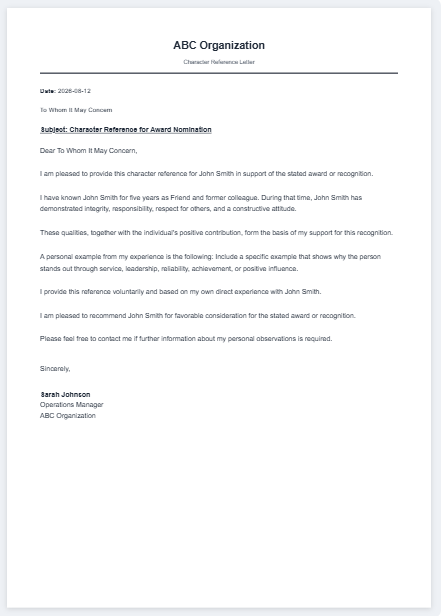
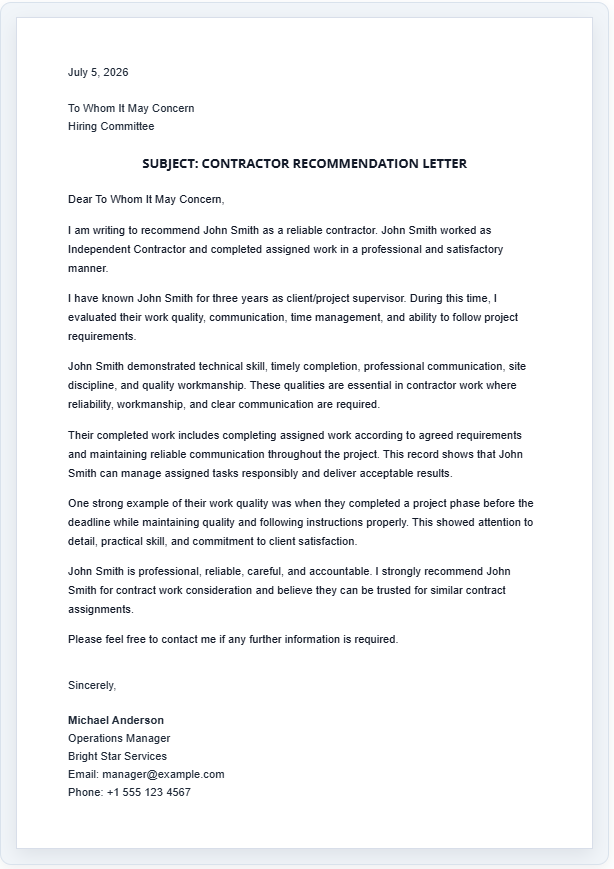
A reference letter can be useful in different situations, such as applying for employment, immigration-related matters, or certain legal proceedings. A character reference letter focuses specifically on an individual’s personal qualities, conduct, reputation, and behavior as observed by someone who knows them well.
When a character reference is prepared for court, it should be factual, sincere, and relevant to the proceedings. The writer should avoid making legal conclusions or attempting to determine the outcome of the case.
What is a Character Reference Letter for Court?
A character reference letter for court is a written statement in which someone who knows an individual personally or professionally describes their character, behavior, reputation, and other relevant qualities.
Depending on the type and stage of the proceedings, such a letter may provide the court with additional information about the individual’s background and character. However, a character reference does not determine guilt or innocence, replace evidence, or guarantee a particular legal outcome.
Its relevance and the weight given to it depend on the circumstances of the case and the applicable court procedures.
When is a Character Reference Letter for Court Needed?
A character reference should be prepared when it is appropriate for the particular legal matter and, preferably, after consulting the individual’s lawyer or legal representative.
The lawyer may advise whether a reference would be useful, what information should be included, who would be an appropriate person to write it, and when it should be submitted.
If a court or legal representative specifies a deadline or particular requirements for supporting documents, these instructions should be followed carefully.
Who Should Write a Character Reference?
An appropriate referee is generally someone who knows the individual well enough to provide an honest and meaningful assessment of their character.
Depending on the circumstances, the writer might be:
- An employer or supervisor
- A Coworker
- A Teacher or professor
- A Coach or mentor
- A Friend
- A Community leader
- Another person who has known the individual for a meaningful period
Whether a relative, spouse, or other person is an appropriate referee can depend on the circumstances and applicable court requirements. The individual or their lawyer should therefore determine who would be most suitable.
The writer should have genuine knowledge of the person and should be comfortable making truthful statements based on personal experience.
Tips for Writing a Character Reference Letter for Court
If you have been asked to write a character reference for someone involved in legal proceedings, the following guidelines can help you prepare an appropriate letter.
Introduce Yourself
Begin by explaining who you are and how you know the person for whom you are writing the reference. Mention how long you have known them and whether your relationship is professional, personal, academic, or community-based.
This context helps the reader understand the basis of your observations.
Describe the Person’s Character
Describe the qualities you have personally observed. These might include honesty, responsibility, reliability, compassion, professionalism, respect for others, or involvement in the community.
Specific examples can make the reference more credible. Instead of simply saying that the person is responsible, you might briefly describe an occasion when they demonstrated responsibility or helped others.
Stay Within Your Personal Knowledge
Do not speculate about facts you do not know. Unless you have direct knowledge of the circumstances, avoid stating that the person is innocent, that the allegations are false, or that the incident was merely a misunderstanding.
The purpose of a character reference is generally to provide information about the person’s character rather than to determine disputed facts or legal responsibility.
Be Honest and Realistic
A court reference should be truthful and balanced. Excessive praise or unrealistic claims may reduce its credibility.
Only include information that you genuinely believe to be accurate and that you would be comfortable standing behind if questioned.
Follow Legal Advice Where Appropriate
Because requirements can vary according to the jurisdiction, type of case, and stage of proceedings, the letter should be reviewed or prepared according to guidance from the person’s lawyer when appropriate.
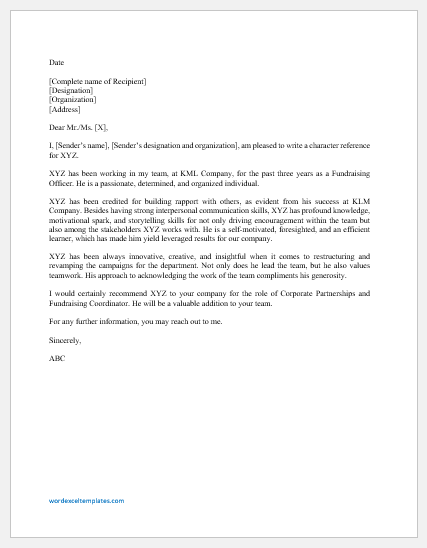
Sample #1
Subject: Character Reference for XYZ
Dear Sir/Madam,
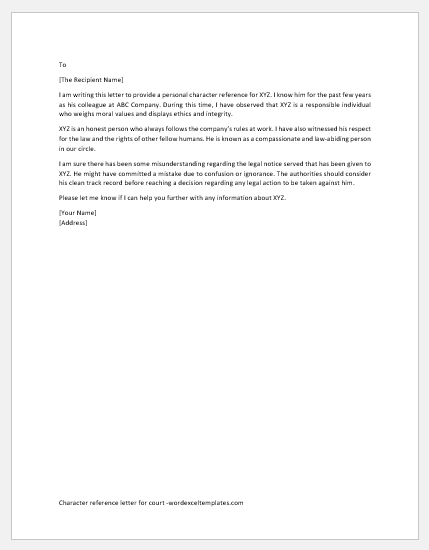
I am writing to provide a character reference for XYZ, whom I have known for the past [number] years as a colleague at ABC Company.
During the time we have worked together, I have found XYZ to be responsible, respectful, and dependable. He takes his professional responsibilities seriously and generally conducts himself with honesty and integrity in his interactions with colleagues.
I have also observed XYZ treating coworkers with respect and offering assistance when colleagues require support. In my personal experience with him, he has demonstrated consideration for others and a strong sense of responsibility.
I understand that XYZ is currently involved in legal proceedings. I am not in a position to comment on the facts of the case, and I leave those matters entirely to the appropriate legal process. I am providing this letter only to describe the character and conduct I have personally observed during the years I have known him.
I respectfully ask that this information be considered to the extent that it is relevant to the proceedings.
If you require any further information regarding my experience with XYZ, please feel free to contact me at [contact information].
Sincerely,
[Name]
[Occupation/Designation]
[Contact Information]
Letter File 67 KB
Sample #2
Subject: Character Reference for XYZ
Dear Sir/Madam,
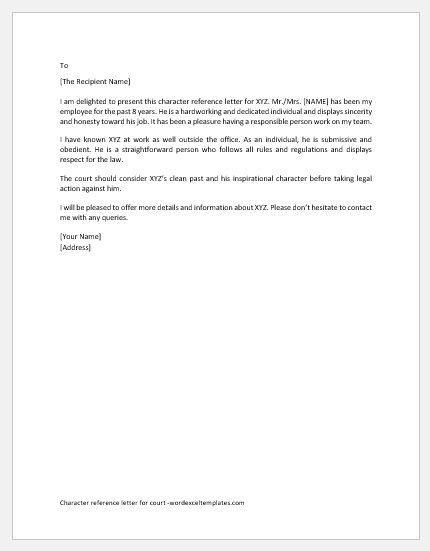
I am writing this character reference for XYZ, who has worked under my supervision for the past eight years.
Throughout his employment, I have found him to be hardworking, dependable, and committed to his responsibilities. He has consistently approached his work professionally and has demonstrated honesty and respect in his interactions with colleagues and management.
I have also had opportunities to know XYZ outside our immediate working environment. Based on my personal experience, I have found him to be respectful, cooperative, and considerate toward others.
One example of his character that stands out to me is [briefly describe a genuine example of responsibility, kindness, community involvement, or other relevant conduct]. This experience contributed to my positive assessment of his character.
I understand that XYZ is currently involved in legal proceedings. I do not intend to comment on the legal issues or disputed facts involved in the matter. My purpose in writing is simply to provide the court with an honest account of the character and conduct I have personally observed during the eight years I have known him.
I hope this information is helpful. If you require any further information, please feel free to contact me at [phone number/email address].
Sincerely,
[Name]
[Designation]
[Company/Organization]
[Contact Information]
Letter File 67 KB