Various circumstances may cause employees to reconsider their decision to continue working for an organization. Workplace dissatisfaction can arise from several factors, including an unhealthy working environment, poor management practices, strained relationships with colleagues, or a lack of professional recognition.
Employers and senior management play an important role in identifying and addressing workplace concerns. Employees may initially try to resolve these issues through communication, adjustments, or discussions with their supervisors. However, when problems persist and begin to affect their job satisfaction or well-being, some employees may decide to resign.
A resignation letter expressing disappointment is a formal document in which an employee communicates their decision to leave an organization while explaining the workplace concerns that contributed to it. The letter provides an opportunity to express dissatisfaction professionally and, where appropriate, bring unresolved issues to management’s attention.
An employee may write a resignation letter expressing disappointment in circumstances such as the following:
- When colleagues repeatedly make inappropriate remarks or engage in disrespectful behavior related to an employee’s age.
- When an employee experiences unfair treatment or is denied professional opportunities because of a disability or health-related condition.
- When excessive working hours interfere with personal responsibilities, work-life balance, or well-being.
- When a supervisor consistently behaves rudely, dismisses employee concerns, or fails to acknowledge professional contributions.
Such situations may gradually lead to frustration and disappointment, particularly when attempts to resolve the problems have been unsuccessful.
When writing a resignation letter under these circumstances, the employee should clearly state the decision to resign and briefly explain the reasons behind it. If relevant, the letter may also mention previous efforts to address the concerns, such as discussions with supervisors or requests for assistance.
Although the employee may feel disappointed, the letter should remain respectful, factual, and professional. Avoid unnecessarily emotional language, personal attacks, or accusations that cannot be supported.
The letter should include the employee’s name, designation, company name, date of resignation, and intended last working day. The employee may also mention their willingness to assist with the transition or handover of responsibilities.
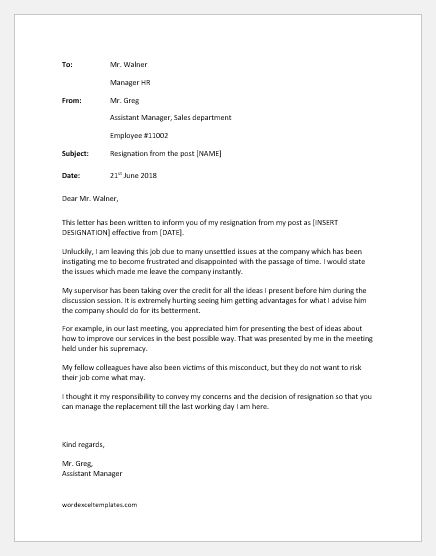
The following sample resignation letter demonstrates how an employee can professionally express disappointment over a lack of recognition and concerns about workplace conduct.
Sample Resignation Letter Expressing Disappointment
Date: [Insert Date]
To:
[Recipient’s Name]
[Designation]
[Company Name]
Subject: Resignation Due to Workplace Disappointment
Dear [Recipient’s Name],
Please accept this letter as formal notification of my resignation from the position of [Designation] at [Company Name], effective [Date]. My last working day will be [Date].
I regret having to make this decision, as I have valued the professional opportunities and experience I have gained during my employment with the company. However, several unresolved workplace concerns have gradually affected my job satisfaction and confidence in the working environment.
One of my primary concerns relates to the acknowledgment of my professional contributions. On several occasions, I have shared ideas and recommendations with my supervisor during departmental discussions, but I believe these contributions have not been appropriately recognized.
For example, during our recent meeting on [Insert Date], my supervisor received appreciation for recommendations concerning improvements to the company’s services. These recommendations were based on ideas I had previously presented during an earlier departmental meeting.
I found this situation particularly disappointing because I had devoted considerable time and effort to developing those suggestions with the intention of contributing to the organization’s improvement.
I have also become aware of similar concerns expressed by some colleagues, although I cannot speak on their behalf or confirm the details of their individual experiences.
Despite my efforts to remain focused on my responsibilities, these ongoing concerns have made it increasingly difficult for me to maintain the same level of professional satisfaction and motivation.
After careful consideration, I have therefore decided to pursue opportunities elsewhere.
I am informing you of my decision in advance so that the company can make the necessary arrangements for my replacement and ensure a smooth transition.
During my remaining period of employment, I will continue to fulfill my responsibilities and assist with the handover of ongoing assignments.
I sincerely appreciate the opportunities I have received during my time with the company. I hope the concerns raised in this letter will be considered constructively to help maintain a fair and supportive working environment.
Thank you for your understanding.
Sincerely,
[Employee’s Name]
[Designation]
[Employee ID, if applicable]
[Signature]