A disciplinary action letter for repeated lateness is a formal notification issued by an employer to an employee who has repeatedly failed to report to work on time. The letter outlines the attendance concerns, refers to previous warnings or discussions where applicable, and communicates the disciplinary measures being taken.
Maintaining regular working hours and following workplace attendance policies are important for ensuring smooth operations within an organization. When employees repeatedly arrive late, their attendance may affect scheduling, coordination, and the timely completion of assigned responsibilities.
Late arrival can be particularly disruptive when an employee’s responsibilities involve supervising teams, attending scheduled meetings, approving work, or coordinating time-sensitive projects. However, employers should consider the circumstances surrounding attendance issues before deciding on disciplinary action.
Organizations commonly address repeated lateness through discussions, attendance reviews, and formal warnings. If the problem continues, further action may be considered in accordance with company policies and applicable employment requirements.
Where a disciplinary committee or formal review process is used, the employer should consider relevant attendance records, previous warnings, the employee’s explanation, and the impact of the reported incidents. Any disciplinary measure should be consistent with organizational procedures and applicable requirements.
The purpose of disciplinary action is generally to address workplace concerns, communicate expectations, and encourage improvement. Employees should be given clear information about the issue and any corrective steps they are expected to take.
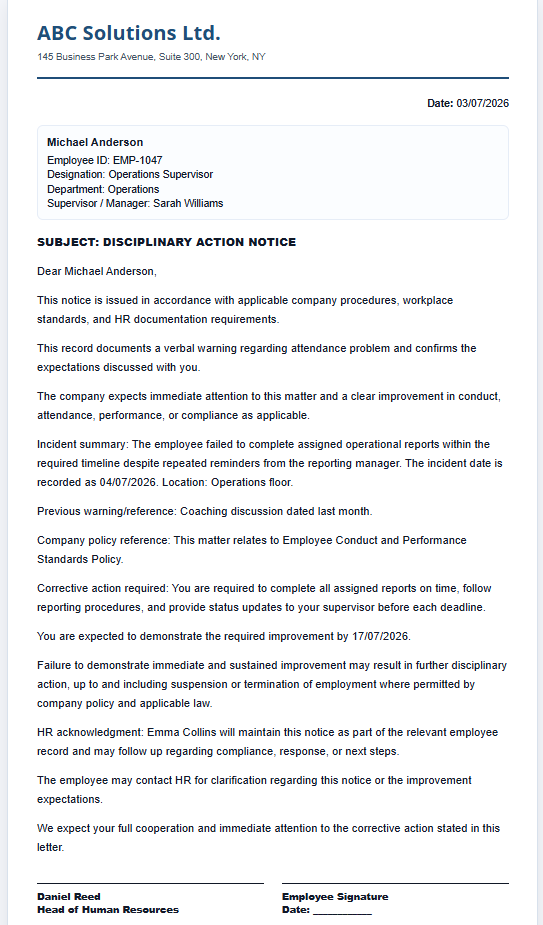
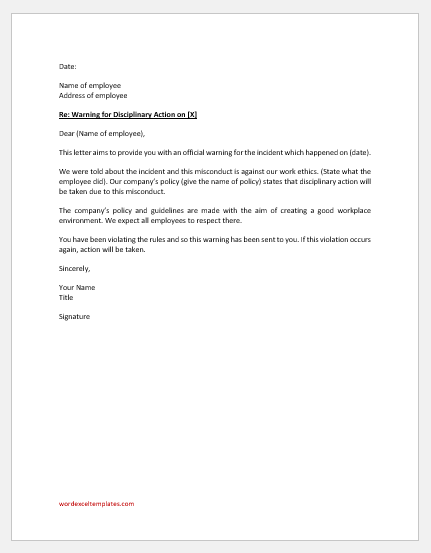
The employee is formally informed of the decision through a disciplinary action letter. Although the contents may vary depending on company policies and the seriousness of the situation, the letter typically includes the following details:
- Date of issuance
- Employer’s name and designation
- Employee’s name and designation
- Description of the attendance concerns
- Dates or details of relevant incidents
- Reference to previous warnings or discussions, if applicable
- Impact of repeated lateness on workplace operations
- Disciplinary action being taken
- Effective date and duration of the action, where applicable
- Expected improvements in attendance
- Possible consequences of further violations
- Information about any available response or appeal process
- Professional closing and signature
Employees should understand the importance of following established attendance requirements and communicating promptly when circumstances prevent them from arriving on time.
Repeated violations may result in further disciplinary measures, depending on the circumstances and applicable workplace procedures. However, employers should avoid assuming that every instance of lateness represents misconduct or that increasingly severe penalties are always necessary.
A clear and professionally written disciplinary action letter provides a formal record of the issue and communicates the expectations for improvement.
Sample Letter
Date: [Insert Date]
To:
Ms. Emily
[Designation]
[Department]
[Company Name]
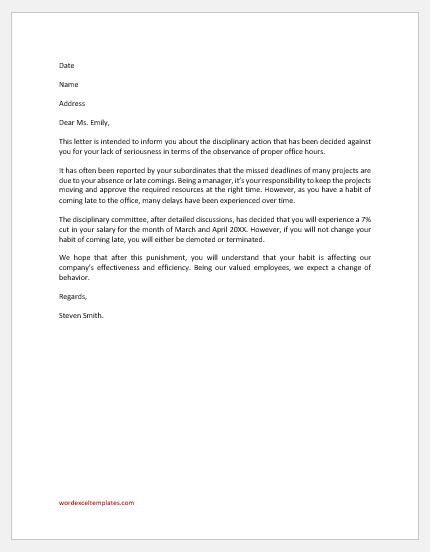
Subject: Disciplinary Action for Repeated Late Arrival
Dear Ms. Emily,
This letter serves as formal notification regarding concerns about your repeated late arrival at work and the disciplinary action being considered in connection with these attendance issues.
According to our attendance records, you have reported to work after your scheduled starting time on several occasions, including [Insert Relevant Dates]. These incidents have previously been discussed with you on [Date(s) of Previous Discussions or Warnings].
As a manager, your responsibilities include overseeing project activities, coordinating team members, providing timely approvals, and ensuring that assigned tasks progress according to schedule.
Your repeated late arrivals have affected the availability of managerial support during scheduled working hours and contributed to delays in certain project-related activities.
Following a review of the attendance records, previous discussions, and relevant circumstances, the disciplinary committee has recommended a 7% salary deduction for March and April 20XX, subject to confirmation that such a measure is permitted under applicable employment laws, your employment agreement, and company policy.
No deduction will be implemented unless the necessary review and authorization requirements have been satisfied. You will be informed separately of the final decision and any applicable right to respond or appeal.
We expect you to report to work at your scheduled starting time and fulfill your managerial responsibilities consistently. If circumstances arise that may affect your attendance, you should inform your supervisor or the appropriate department as soon as reasonably possible.
Please be aware that further attendance violations may result in additional disciplinary action, subject to company procedures and applicable employment requirements. Depending on the circumstances, such action could include further formal warnings or other measures permitted under the relevant policies.
We value your contributions to the organization and encourage you to address these concerns promptly. We hope to see a sustained improvement in your punctuality and overall attendance.
Please contact the HR department if you would like to discuss this matter or provide additional information for consideration.
Sincerely,
Steven Smith
[Designation]
[Company Name]