A Certificate of Origin is an important document used in international trade to certify the country where goods were manufactured, produced, or processed. Customs authorities, importers, exporters, and chambers of commerce often require this certificate to determine applicable duties, verify eligibility under trade agreements, and ensure compliance with import regulations. Since the document contains several essential details, preparing it manually can be time-consuming and may increase the chances of errors or omissions.
Our Online Certificate of Origin Template offers a fast and convenient way to create professional certificates directly from your web browser. The tool includes editable fields for exporter and importer information, manufacturer details, invoice references, transport information, countries of origin and destination, and exporter declarations. Users can add multiple product entries with descriptions, quantities, package details, gross weight, and HS codes through dynamic item rows.
Once the required information has been entered, the completed certificate can be instantly printed or downloaded as a PDF while maintaining a professional A4 layout. Designed specifically for our website, this online tool enables businesses and individuals to generate accurate and well-organized Certificate of Origin documents without the need for specialized software.
Certificate of Origin Generator
Enter the exporter and consignee details, the shipment details and the goods, then add the declaration and the name of the person who signs. The totals are worked out for you. Check the preview, then print the certificate or save it as a PDF, or download an editable Word document. Leave a detail empty to write it by hand. Your details stay in your browser and are not sent anywhere. This certificate is a sample prepared for help and guidance only. It is not intended for legal or any other official purpose.
Exporter or Producer
Consignee
Shipment Details
Goods
Declaration
The statement says that the exporter states the goods originated in the country of origin. It makes no customs or trade claims.
Page & Style
For MS Word and Excel
Some rules and regulations must be followed if you are pursuing international trade. Businesses need to respect these rules if they do not want to face any penalties. It is important to know which laws are present in your country and also the country where you are sending goods so that these can be followed.
For instance, there are ways that the goods need to be marked. You need to follow weight limitations, etc. There are even certain documents that you need to get so that you can transport products internationally. One document includes a certificate of origin.
What is a certificate of origin?
This is a document that lets the authorities and concerned individuals know which country the goods that are being exported originated from. The certificate is usually needed when it comes to customs clearance so that duties and the legitimacy of the imports can be figured out.
What does a certificate of origin do?
The certificate confirms which country certain goods have originated from that are being imported. The document is employed in international trade to let the authorities decide whether goods are allowed to enter the country they are being sent to. It gives important information about the goods that are being exported.
Preview and Details of Template
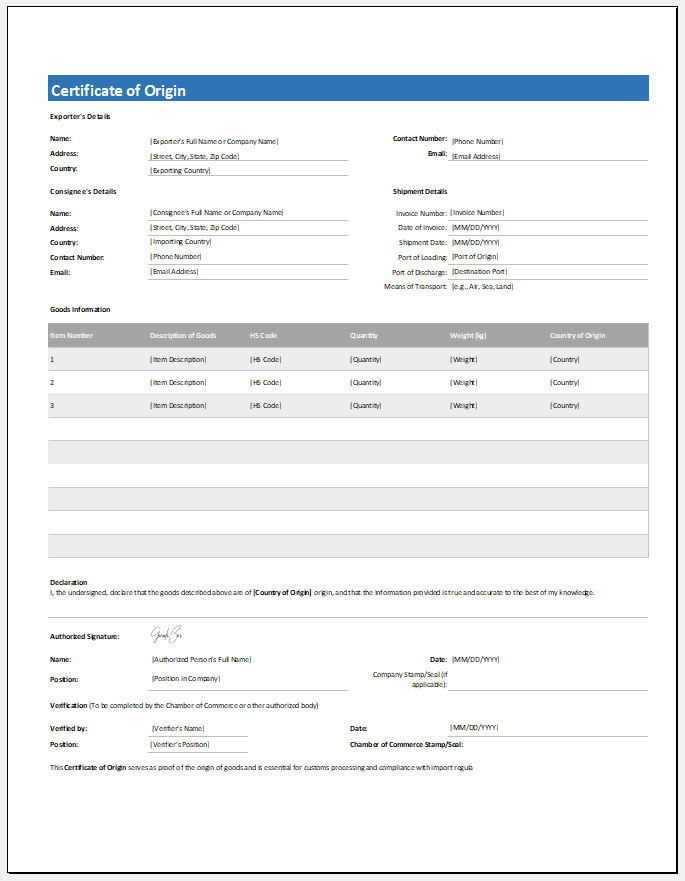
File: Word (.doc) and iPad
Size 21 KB
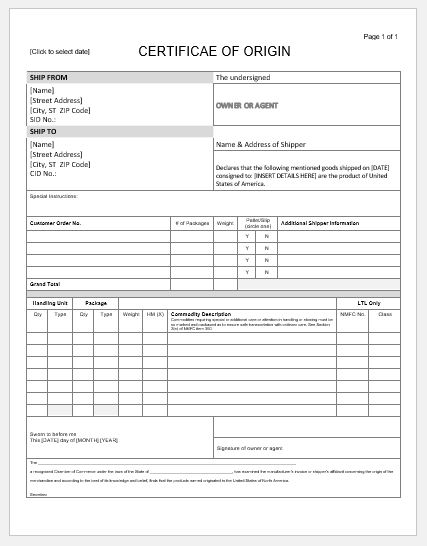
File: Word (.doc) and iPad
Size 21 KB
What is included in a certificate of origin?
Exporters can issue this certificate. You can get hold of the relevant authorities in your country that deal with international trade to determine the procedure. The following includes details about a certificate of origin that you need to know about:
Details about the producer:
The certificate includes the name and contact details of the manufacturer of the goods. The place of origin is also included.
Details about exporting individuals:
The name and contact details of the agent who is exporting the goods will be mentioned on the certificate.
Details about the receiver:
It is necessary to state the name and contact details of the agent importing the goods or the receiver.
Details about goods:
The document needs to include information related to the good or goods that are being imported. This will consist of details like the required product codes. This information can be included in a table format that states the code, quantity, any marks or numbers on the packages, description of goods, origin criteria, weight, date of invoices, etc. of the goods.
Transportation details:
A section that includes information about the product’s means of transportation and route details must be present. The departure date, vessel name, and discharge port can be included here.
Invoice of payment:
A commercial invoice of payment is required that should be dated as well.
Official details:
There will be a place for the certificate number. On the certificate, it needs to be mentioned which country’s certificate of origin it is. A section for certifying authority employment can only include the stamp of the authority.
Declaration:
There will be a declaration by the exporter that states that the above information is correct and that the goods are manufactured in the specified country. They comply with any Rules of Origin in the country. The authorized signatory will include the place plus date, signature, and stamp.
Certification:
This section will let the reader know that the declaration given by the exporter is right. Include the place, date, signature, and stamp of the certifying authority here.
It is an important document.
It is important to have this certificate if you are doing international trade as it follows customs requirements within the country where the goods will be made. The certificate will help authorities determine how much duty must be paid. Some products may have tariff reductions, and some may even be included in the category of tariff exemptions.
This includes goods from some countries or goods that are a particular type. This information can be known with the help of the certificate of origin. The certificate will also note down who the exporter is so that this information is known to the authorities and those who need to know this.