We often need to write an authorization letter when we want another person to perform a specific task on our behalf. One common situation is when we are unable to visit an organization personally to collect important documents, certificates, payments, or other items.
Organizations are usually careful when releasing important or confidential documents to someone other than the person to whom they belong. For example, if you need to collect your original degree from a college or university, the institution may not release it to another person without your written permission. In such a situation, you may be asked to provide an authorization letter clearly identifying the person who is permitted to collect the document on your behalf.
What is an Authorization Letter for Collection?
An authorization letter for collection is a formal letter in which an applicant gives another person permission to collect specified documents, certificates, payments, or other items on their behalf.
The letter usually identifies both the applicant and the authorized person and clearly states what the authorized person is permitted to collect. Depending on the organization’s requirements, the applicant may also explain why they are unable to collect the item personally.
When to Write an Authorization Letter
An authorization letter may be required in various situations. For example:
- When the applicant is living or traveling abroad and cannot personally visit the organization to collect the required documents.
- When the applicant is unable to visit because of illness, physical limitations, travel, work commitments, or other unavoidable circumstances.
- When important documents, certificates, payments, or other items need to be collected within a specific period.
- When an organization requires written permission before releasing documents or property to another person.
What is the Purpose of an Authorization Letter?
The primary purpose of an authorization letter is to provide formal permission for another person to act on the applicant’s behalf for a specific purpose.
It also helps the organization verify that the applicant has willingly authorized the individual to collect the specified item. The applicant can clearly define the scope of the authorization so that the authorized person is permitted to perform only the actions stated in the letter.
What Should Be Included?
Applicant’s Information
Begin the letter by providing your name and any relevant identifying information. If the authorization relates to an application, enrollment, account, or other official record, include the appropriate application number, registration number, or reference number.
Avoid including unnecessary personal information unless it is specifically required by the organization.
Information About the Authorized Person
Clearly state the full name of the person you are authorizing to collect the documents or other items on your behalf.
Depending on the organization’s requirements, you may also need to provide additional identification details or a copy of the authorized person’s identification document for verification.
Specify the Authorization
Clearly state what the authorized person is permitted to collect or do on your behalf. For example, you may authorize the person to collect your degree, certificate, official documents, payment, package, or other specified item.
If the person is also permitted to sign a receipt or acknowledgment of collection, mention this separately and only if necessary.
Explain the Reason
Briefly explain why you are unable to collect the documents or items personally if the organization requires a reason. Keep the explanation simple and relevant.
Points to Remember
- Keep the authorization letter brief and include only the necessary information.
- Clearly identify both yourself and the person you are authorizing.
- Specify exactly what the authorized person is permitted to collect or do.
- Sign and date the letter properly.
- If the authorization is being issued on behalf of a business, use official company letterhead where appropriate.
- Attach identification or supporting documents only when required by the organization.
- Check the organization’s collection requirements beforehand, as some institutions may require a specific authorization form or additional verification.
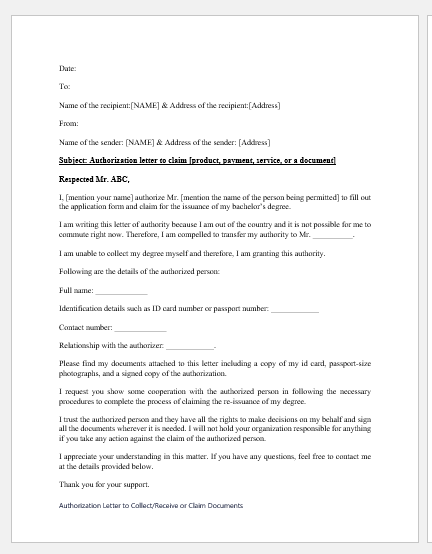
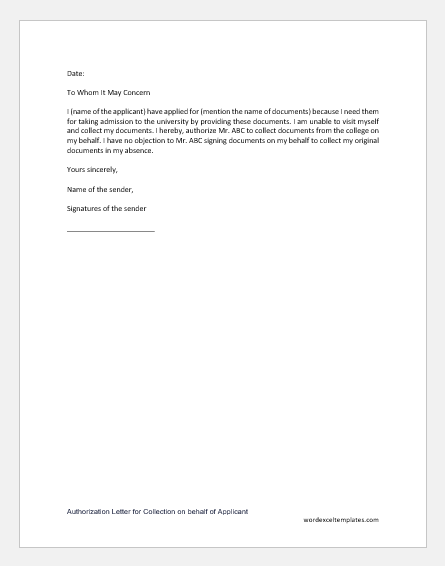
Sample Authorization Letter
Date: [Date]
To:
[Recipient’s Name/Department]
[College/Organization Name]
[Address]
Subject: Authorization to Collect Documents on My Behalf
Dear Sir/Madam,
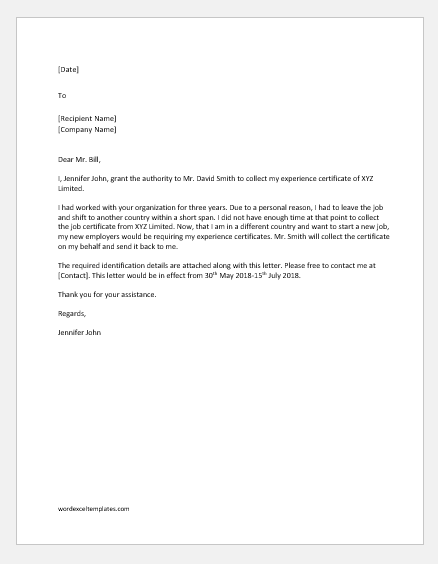
I, [Applicant’s Full Name], have applied for [name of document/certificate] under application/reference number [number]. As I am unable to visit the institution personally due to [brief reason, if necessary], I hereby authorize Mr./Ms. [Authorized Person’s Full Name] to collect the document(s) on my behalf.
I authorize the above-mentioned person to receive the specified document(s) and, if required, sign the acknowledgment or receipt confirming their collection.
For identification and verification purposes, I have attached the required supporting documents.
I would appreciate your cooperation in releasing the document(s) to the authorized person.
Thank you.
Yours sincerely,
[Applicant’s Name]
[Signature]
[Application/Registration Number]
[Contact Details]
File: Word (.docx)
Size 22 KB