Businesses need clear ways to present their products and services to customers. A well-structured product catalog combined with a pricing form helps customers review available options, understand their features, and compare costs before purchasing.
This template can be useful for retailers, wholesalers, service providers, and online businesses that want to organize product information and communicate prices consistently.
What is a Product Catalog?
A product catalog is a document that lists products or services offered by a business. It provides information about each item so customers can understand what is available.
A typical product catalog includes:
- Product or service name
- Description and key features
- Specifications, such as size, material, or color
- Product images, where useful
- Categories that group similar offerings
The main purpose of a product catalog is to help customers explore a business’s offerings in one place. It may cover the full range or a selected collection, depending on its purpose.
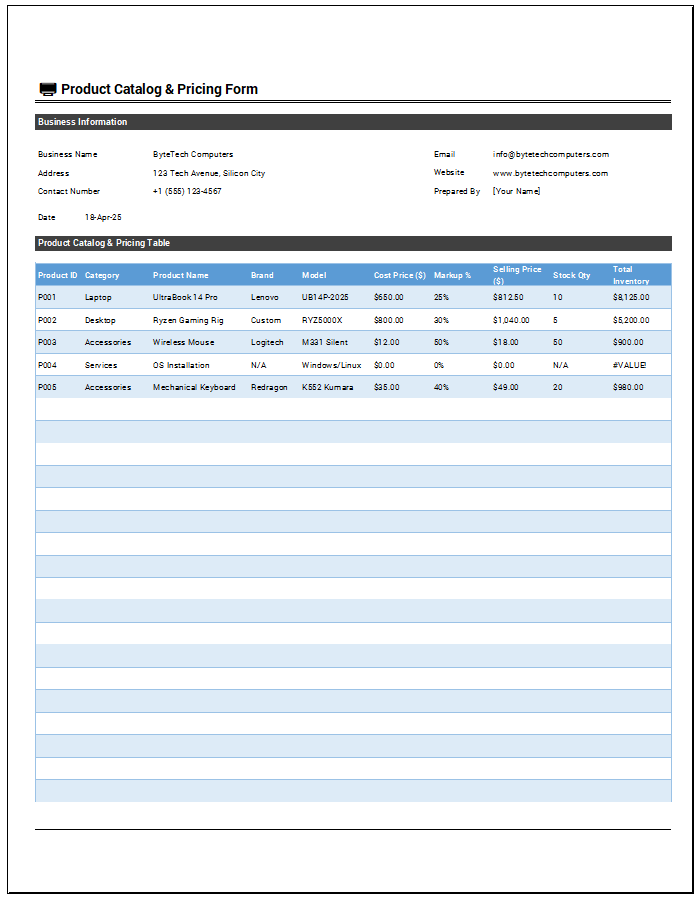
(Create a catalog below)
Product Catalog & Pricing Form
Build a product catalog, set selling prices, and review profit margins.
Catalog Details
Catalog Products
Add a product, then enter cost, markup, selling price and stock quantity.
Pricing Policy
Review & Export
Check product count, stock value, selling prices and estimated margins.
What is a Pricing Form?
A pricing form or price sheet outlines the charges for products or services. It may appear within the catalog or as a separate document.
A pricing form may include:
- Unit price or service rate
- Bulk or wholesale pricing, if applicable
- Discount rates and promotional offers
- Tax details and additional charges
- Quantity and total cost calculations, where relevant
Clearly stated prices and conditions help customers understand the expected cost and reduce misunderstandings.
Importance of a Product Catalog & Pricing Form
A combined product catalog and pricing form provides several advantages:
- Product awareness: Customers can review the business’s offerings in an organized format.
- Easier comparison: Descriptions, specifications, and prices help customers compare suitable options.
- Convenient reference: Customers and sales staff can find key information without gathering it from several sources.
- Pricing clarity: Showing discounts, taxes, and additional charges helps explain how costs are calculated.
- Professional presentation: A well-designed catalog makes information easier to read and reflects attention to detail.
- Promotion of offers: Businesses can highlight seasonal offers, bundle deals, or limited-time discounts along with their conditions.
Key Features of the Template
A Product Catalog & Pricing Form Template should be easy to navigate and update. It typically includes the following sections:
Company Information
This section identifies the business. It may include:
- Company name and logo
- Contact details, including phone number, email address, and website
- Physical address, where relevant
- Social media links, if useful
- Issue date, version number, and pricing validity period
Product Listing Section
Group products into categories where this makes browsing easier. Each entry may include:
- Product name
- Image, where appropriate
- Description
- Features and specifications
- SKU or product code for identification and ordering
Pricing Section
This section records the applicable prices and explains any conditions. It may include:
- Standard unit price or service rate
- Discounted price
- Wholesale or bulk rates
- Applicable taxes
- Additional charges
- Currency and unit of sale
- Calculated total, where quantities are entered
State whether listed prices include taxes and whether delivery or other charges are calculated separately.
Discounts & Promotions Section
A separate section can highlight offers such as:
- Seasonal sales
- Buy-one-get-one offers
- Limited-time discounts
- Bundle pricing
Include relevant dates, minimum quantities, exclusions, and other conditions so customers understand when an offer applies.
How to Create a Product Catalog & Pricing Form?
Focus on clear descriptions, accurate prices, and a layout suited to your audience.
- Keep information current: Review product details, availability, prices, and promotional terms regularly.
- Use a structured layout: Organize products into categories and apply consistent headings and formatting.
- Include useful visuals: Choose clear images that accurately represent the products. Images may be less necessary for some services or technical price lists.
- Use tables for pricing: Align product codes, units, prices, and conditions so comparisons are easy.
- Include only relevant details: Keep descriptions concise and provide references or links to further specifications where needed.
Benefits of Using an Excel-Based Template
Using an Excel template can make a product catalog and pricing form easier to maintain through:
- Easy editing and updates
- Formula-based calculations for discounts, taxes, and totals
- Consistent organization in rows and columns
- Sorting and filtering by product category, code, or price
- Reuse of the layout for different product ranges
Depending on how the workbook is set up, formulas can calculate discounted prices, tax-inclusive amounts, and order totals. Check the formulas and inputs before sharing calculated prices with customers.
Excel can be practical for managing product data, although a separate print or PDF layout may be useful for customer-facing distribution.
Limitations of the Form
Some challenges to consider include:
- Keeping information consistent across different sales channels.
- Updating printed catalogs when prices or products change.
- Managing lengthy documents with large product ranges.
- Checking formulas, promotional terms, and pricing accuracy regularly.
Digital formats can simplify updates, but clear version control and regular reviews are still needed.
Using the Template Effectively
A Product Catalog & Pricing Form Template brings product descriptions and pricing information together in a consistent format. It helps businesses communicate their offerings and gives customers a useful reference when comparing options.
Whether distributed in print, as a PDF, or as an Excel file, the document is most useful when its information is accurate, relevant, and easy to find. Customize the template to suit your products, pricing structure, and customers’ needs.
File: MS Excel (.xlsx) Size: 432 KB