Petty cash refers to a small amount of money kept on hand for official business use. It serves as an easily accessible cash reserve maintained by organizations to handle minor, routine expenses such as office supplies, refreshments, transportation, or small repairs. Using petty cash eliminates the need for writing checks or making frequent bank withdrawals for low-value transactions.
However, just like funds held in a bank account, petty cash must be carefully monitored and properly recorded to ensure accuracy, accountability, and transparency.
Role of the Petty Cash Custodian
Managing petty cash is typically assigned to a trustworthy employee or accountant, known as the petty cash custodian. This individual is responsible for:
- Safeguarding the petty cash fund
- Recording all withdrawals and deposits
- Maintaining supporting documents such as receipts and vouchers
- Reporting balances to management
The custodian is fully accountable for every transaction made from the petty cash fund. Any discrepancies must be explained, making this role one that requires honesty, attention to detail, and responsibility.
Understanding Key Petty Cash Terms
Before maintaining a petty cash log, it is important to understand some key concepts:
Petty Cash Float
The petty cash float is the fixed amount of money initially allocated to the petty cash fund. This amount represents the maximum balance that should be available at any given time.
At the end of a business cycle (daily, weekly, or monthly), the fund is replenished to restore it to its original float amount. Any excess cash received, especially from larger payments, is usually deposited into the company’s main bank account rather than kept in petty cash.
Petty Cash Voucher
A petty cash voucher is a small document used to record individual transactions. Each time money is spent, a voucher is created as proof of the expense.
Printed vouchers are highly recommended because they include predefined fields such as date, amount, purpose, and authorization. This ensures that no critical information is missed and that all entries are consistent and easy to verify.
How the System Works
In practice, every petty cash transaction is first recorded on a voucher. At the end of the day or accounting period, these vouchers are used to update the petty cash log.
This step-by-step process:
- Ensures accuracy in record-keeping
- Reduces the chances of errors or omissions
- Provides a clear audit trail for review
What is a Petty Cash Log Template?
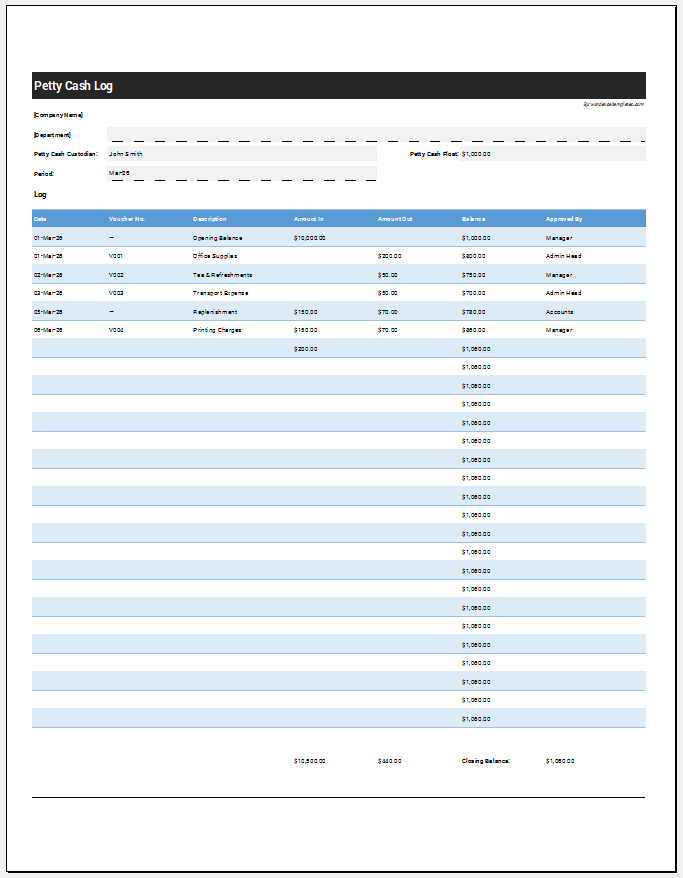
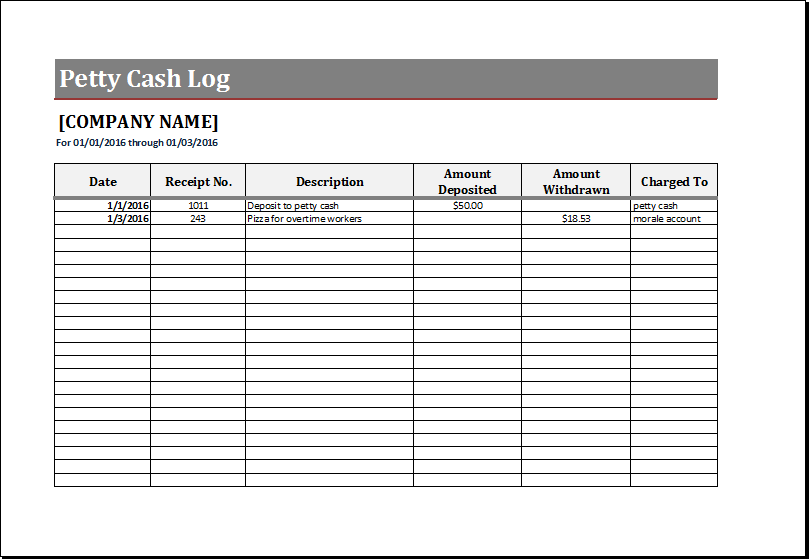
A petty cash log template is a structured document or worksheet used to record all petty cash transactions in an organized manner. It acts as a central record where daily cash inflows and outflows are documented systematically.
A well-designed petty cash log typically includes:
- Date of transaction
- Voucher or receipt number
- Description of the expense
- Amount paid out
- Amount received (replenishment)
- Running balance
- Approval or authorization details
By maintaining this log, businesses can easily track how petty cash is being used and ensure that no transaction goes unrecorded.
Benefits of Using a Petty Cash Log Template
Using a pre-designed petty cash log template offers several advantages:
- Improved organization: All transactions are recorded in a clear and structured format
- Time-saving: No need to create a log from scratch
- Error reduction: Built-in formats help minimize calculation and recording mistakes
- Better control: Helps prevent misuse or mismanagement of funds
- Easy auditing: Records can be reviewed quickly when needed
Conclusion
Maintaining petty cash may seem like a minor task, but it plays a crucial role in financial management. A properly maintained petty cash log ensures that even the smallest expenses are tracked and accounted for. By using a reliable template and following a disciplined process, businesses can simplify record-keeping, improve accountability, and maintain accurate financial records with ease.
File: MS Excel (.xlsx)
Option #2
File: MS Excel (.xlsx)
- Reimbursement Management Forms
- Financial and Assistance Benefits Forms
- Forms Used for Workplace Ethics and Policies
- Summer Vacation Planner
- Outlet Mall Shopping Planner
- Customer Information and Ranking Sheet
- Small Family Kitchen Design Planning Sheet
- Summer Party Budget Sheet
- Payroll Register & Salary Sheet
- Forms used for Operations in an Organization
- Procurement/Supply Chain Forms
- Employee Skill Development Tracker
- HR Budget & Expense Tracker
- Leave & Vacation Tracker Template
- Exit/Off-boarding Checklist