Businesses today need clear and effective ways to showcase their products and services to customers. A well-structured product catalog combined with a pricing form plays an important role in this process. It not only presents what a business offers but also helps customers make informed purchasing decisions by clearly displaying product details and pricing information.
This template is especially useful for retailers, wholesalers, service providers, and online businesses that want to maintain transparency, improve customer experience, and streamline sales communication.
What is a Product Catalog?
A product catalog is a document that contains a complete list of products or services offered by a business. It provides detailed information about each item so that customers can easily understand what is available.
A typical product catalog includes:
- Product or service name
- Description and key features
- Specifications (size, material, color, etc.)
- Product images (in digital formats)
- Categories or grouping of similar items
The main purpose of a product catalog is to help customers explore available offerings in one place without confusion. It acts as a reference guide that represents the company’s full range of products or services.
What is a Pricing Form?
A pricing form is a section (often included within the catalog or as a separate sheet) that clearly outlines the cost of each product or service. It ensures that customers are fully aware of pricing details before making a purchase decision.
A pricing form may include:
- Unit price of each product
- Bulk or wholesale pricing (if applicable)
- Discount rates and promotional offers
- Tax details or additional charges
- Total cost calculations
The pricing form is essential because it brings transparency to the buying process and eliminates confusion regarding costs.
Importance of a Product Catalog & Pricing Form
A combined product catalog and pricing form provides several advantages for both businesses and customers.
1. Better Product Awareness: Customers can easily understand what a company offers without needing to visit multiple pages or locations. Everything is organized in one place.
2. Easier Decision-Making: When product details and prices are clearly displayed, customers can compare options and decide more confidently.
3. Time-Saving for Customers: Instead of searching for product information separately, customers can quickly find everything they need in one document.
4. Price Transparency: Clear pricing builds trust. Customers feel more comfortable when they know exactly what they are paying for, including discounts or additional charges.
5. Improved Business Image: A well-designed catalog reflects professionalism. It shows that the business is organized, reliable, and customer-focused.
6. Promotion of Offers and Discounts: Businesses can highlight seasonal offers, bundle deals, or limited-time discounts directly within the catalog, increasing sales opportunities.
Key Features of the Template
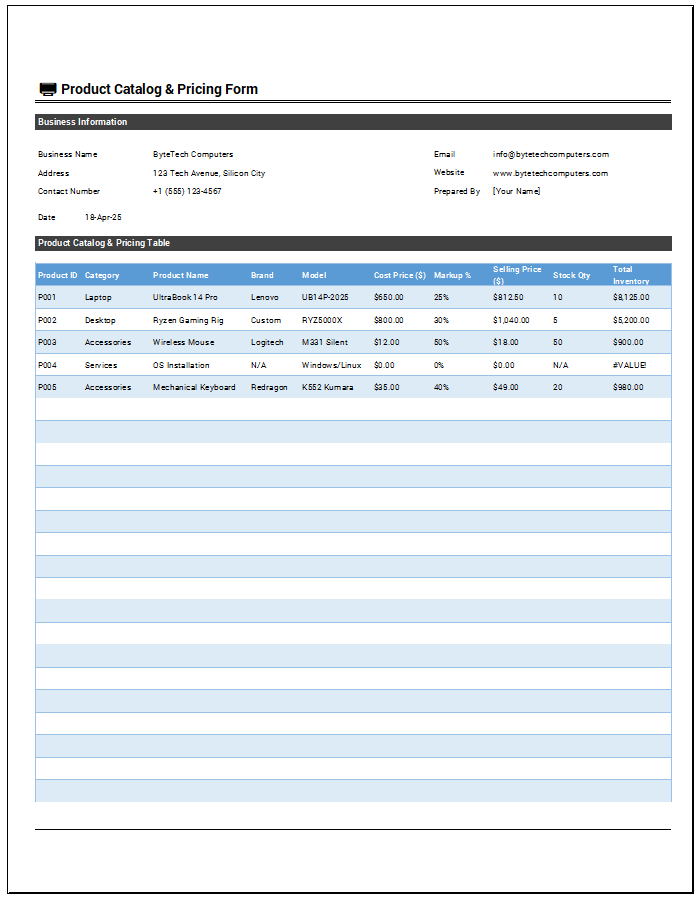
A properly designed Product Catalog & Pricing Form Template should be structured, easy to read, and visually organized. It typically includes the following sections:
Company Information
This section introduces the business and builds brand identity. It may include:
- Company name and logo
- Contact details (phone, email, website)
- Physical address
- Social media links
- Validity period of the catalog (important for pricing accuracy)
Product Listing Section
This is the core part of the catalog. Products are usually arranged in categories for better readability. Each product entry should include:
- Product name
- Image (for visual identification)
- Description
- Features and specifications
- SKU or product code (if used internally)
Pricing Section
This section clearly outlines all costs related to each product or service. It may include:
- Standard price
- Discounted price
- Wholesale or bulk rates
- Applicable taxes
- Final payable amount
Discounts & Promotions Section
A separate section for offers helps attract customer attention. Examples include:
- Seasonal sales
- Buy-one-get-one offers
- Limited-time discounts
- Bundle pricing
How to Create a Product Catalog & Pricing Form
When designing this document, clarity and accuracy are essential. A poorly structured catalog can confuse customers, while a well-designed one improves sales and trust.
1. Keep Information Accurate and Updated: All product details and prices must be correct. Even small errors can lead to customer dissatisfaction or financial loss.
2. Use a Clean and Structured Layout: Organize products into categories. This makes it easier for customers to find what they are looking for quickly.
3. Include Visual Elements: Images significantly improve understanding and engagement. Customers can instantly recognize products visually.
4. Use Tables for Pricing: Tables are highly effective for displaying structured pricing data. They improve readability and make comparisons easier.
5. Avoid Overloading Information: Only include relevant details. Too much unnecessary information can confuse customers and reduce the effectiveness of the catalog.
Benefits of Using an Excel-Based Template
Using an Excel template for a product catalog and pricing form offers additional advantages:
- Easy editing and updates
- Automatic calculations for totals, discounts, and taxes
- Better organization through rows and columns
- Ability to filter and sort products
- Quick duplication for multiple product categories
For example, Excel formulas can be used to calculate:
- Total price after discount
- Tax-inclusive pricing
- Bulk order savings
This makes the template highly practical for businesses with frequently changing prices or large inventories.
Limitations of the Form
Although highly useful, there are a few limitations to consider:
- Maintaining consistent and updated information across all platforms can be challenging
- Printed catalogs can become outdated quickly and may require costly reprints
- Large product ranges may make the document lengthy and harder to manage
- Requires regular monitoring to ensure pricing accuracy
However, these limitations can be minimized by using digital formats like Excel or cloud-based catalogs.
Summary
A Product Catalog & Pricing Form Template is an essential business tool for presenting products and services in a clear, structured, and professional manner. It improves communication between businesses and customers, increases transparency, and supports better purchasing decisions.
By combining detailed product information with clear pricing, businesses can enhance customer trust, improve sales performance, and strengthen their overall brand image. Whether used in printed form or as a digital Excel sheet, this template is a valuable asset for any organization looking to present its offerings effectively.
File: MS Excel (.xlsx) Size: 432 KB
- Reimbursement Management Forms
- Financial and Assistance Benefits Forms
- Forms Used for Workplace Ethics and Policies
- Forms used for Operations in an Organization
- Procurement/Supply Chain Forms
- Downloadable Forms for Unprofessional Behavior
- Commonly Downloaded Office Forms
- Leave Application–Related Forms
- Employee Dispute & Grievance Forms
- Insurance & Protection Benefit Forms
- Employee Retirement & Pension Forms
- Employee Service & Tenure Forms
- Employee Health & Well-being Forms
- Employee Scrutiny & Evaluation Forms
- Employee Training and Development Forms