Compound Interest Calculator

Reviewed & updated by Updated Originally published

A compound interest calculator estimates how money may grow when interest is added to both the original principal and previously earned interest. Enter your starting amount, annual interest rate, investment period, and compounding frequency to estimate the future value of your savings or investment.

This calculator also supports recurring contributions, contribution timing, estimated inflation, and tax on interest. The results show the projected future value, total contributions, interest earned, inflation-adjusted value, and a year-by-year growth schedule. These figures make it easier to compare different saving and investment scenarios.

Compound-interest projections are estimates rather than guaranteed investment returns. Actual results can differ because of changing interest rates or investment performance, fees, taxes, withdrawals, contribution timing, and inflation. Use the calculator for planning and comparison, and verify important financial decisions using the terms of the relevant savings or investment product.

Compound Interest Calculator

Estimate investment growth with flexible interest rates, compounding periods, and recurring contributions.

Investment Details

$
%
years

Recurring Contributions

$

Advanced Options

%
%
Live Investment Projection

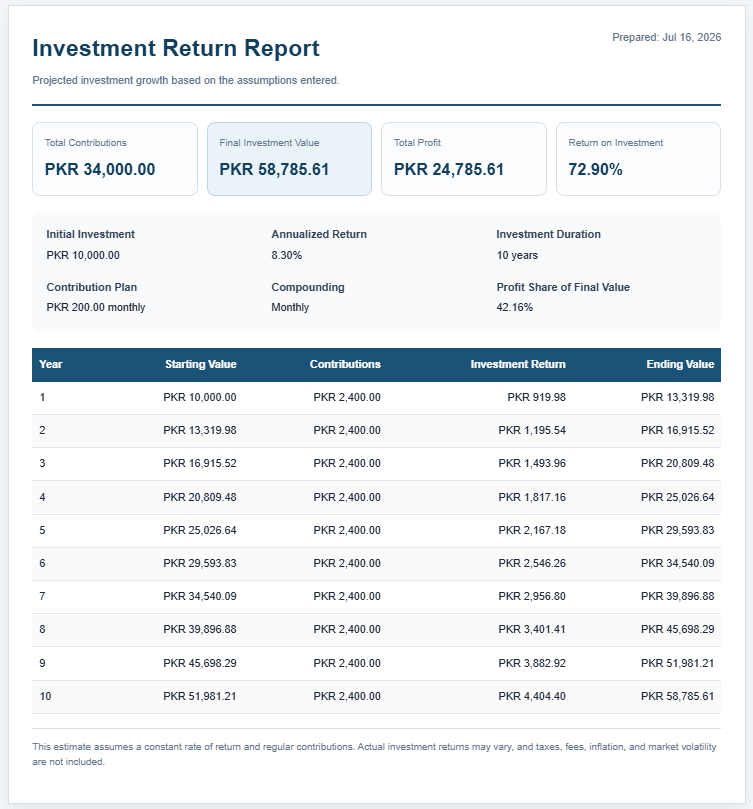
Investment Growth Projection

Compound interest and recurring contribution estimate

Generated:
Future Value$0.00
Total Contributions$0.00
Interest Earned$0.00
Inflation-Adjusted Value$0.00

Calculation Summary

  • Initial investment
  • Annual rate after tax
  • Compounding
  • Investment term
  • Recurring contribution
  • Effective annual yield

Growth Composition

Deposits
Interest
YearStarting BalanceContributionsInterestEnding Balance
This estimate is for planning purposes only. Actual investment returns, fees, taxes, inflation, and contribution timing may change the final result.

Frequently Asked Questions

Helpful answers about compound interest, contribution timing, inflation, and investment growth.

1. What is compound interest?

Compound interest is interest calculated on both the original amount invested and the interest already earned. As interest is added to the balance, future interest is calculated on a larger amount, which can accelerate growth over time.

2. How does this compound interest calculator work?

The calculator uses your starting investment, annual interest rate, investment term, compounding frequency, and recurring contributions to estimate future value. It also produces a yearly schedule showing deposits, interest earned, and ending balances.

3. Why does compounding frequency matter?

More frequent compounding allows earned interest to be added to the balance sooner. With the same stated annual rate, daily or monthly compounding generally produces a slightly higher future value than annual compounding.

4. What is the difference between simple and compound interest?

Simple interest is calculated only on the original principal. Compound interest is calculated on the principal plus previously accumulated interest, so it normally creates faster long-term growth.

5. How do recurring contributions affect investment growth?

Regular contributions increase the amount available to earn interest. Consistently adding money each month, quarter, or year can significantly increase the final balance, especially over a long investment period.

6. Should contributions be made at the beginning or end of each period?

Beginning-of-period contributions generally produce a higher future value because each deposit remains invested for one additional contribution period. End-of-period contributions are often used when deposits are made after income is received.

7. What does inflation-adjusted value mean?

Inflation-adjusted value estimates the future balance in today’s purchasing power. It helps show how rising prices may reduce the real value of the money accumulated over time.

8. How is tax on interest used in the calculation?

The tax setting reduces the annual interest rate used for the projection. It provides a simplified estimate of after-tax growth, although actual tax treatment can vary by account type, investment, and country.

9. Is the estimated future value guaranteed?

No. The result is a planning estimate based on the values entered. Actual returns may vary because of market performance, changing rates, fees, taxes, missed contributions, withdrawals, and other factors.

10. Can I print or save the investment projection?

Yes. Use the Print / PDF button to print only the live investment report or save it as a PDF through your browser’s print dialog. The calculator inputs and FAQ section are excluded from the printed report.
How Compound Interest Is Calculated

Compound interest is calculated by applying interest not only to the original principal but also to interest accumulated during previous compounding periods. This causes the balance to grow progressively over time.

For a single initial investment without additional contributions, the basic formula is:

A = P(1 + r/n)^(nt)

Where:

  • A = future value of the investment
  • P = initial principal
  • r = annual interest rate expressed as a decimal
  • n = number of times interest is compounded per year
  • t = number of years

For example, if $10,000 earns 6% annually and compounds monthly for 10 years, the calculator divides the annual rate into monthly periods and applies compounding throughout the investment term.

When recurring contributions are included, each contribution has a different amount of time to earn compound growth. The calculator therefore accounts for the contribution amount, frequency, and whether contributions are made at the beginning or end of each period.

Why Compounding Frequency Matters

Interest may be compounded annually, semiannually, quarterly, monthly, daily, or at another frequency. More frequent compounding generally produces a slightly higher future value when the stated annual rate and all other assumptions remain the same.

The calculator is intended for estimates and scenario comparisons. Actual savings or investment results may differ because of product terms, changing rates, fees, taxes, contribution timing, withdrawals, and other factors.

Understanding Your Results

The calculator separates the projected ending balance into the money you contribute and the growth generated through compounding. When reviewing the results, pay attention to these figures:

  • Future Value: The estimated total balance at the end of the selected period.
  • Total Contributions: Your initial principal plus any recurring contributions made during the calculation period.
  • Interest Earned: The portion of the projected balance generated by compound interest rather than your contributions.
  • Inflation-Adjusted Value: An estimate of what the future balance may be worth in today’s purchasing power when an inflation rate is entered.
  • Year-by-Year Growth: A breakdown showing how the balance may develop over the selected period.

Try changing one assumption at a time—such as the interest rate, investment period, monthly contribution, or compounding frequency—to understand how it affects the result. This makes the calculator particularly useful for comparing different saving scenarios.

The results are mathematical projections based on the information entered. They do not predict the performance of a particular bank account, investment, security, or financial product.