People sometimes behave unprofessionally in the workplace. Employers need to address such conduct because it can affect teamwork, customer relationships, and productivity.
Company policies establish standards of conduct for employees to follow. When employees fail to meet these standards, management may need to address the issue and take appropriate corrective action. Consistent enforcement helps create a professional workplace where expectations are clear.
There are many types of conduct that may be considered unprofessional. Some examples are:
- Irresponsible behavior – Failing to fulfill assigned responsibilities.
- Unjustified delays – Repeatedly delaying tasks or missing deadlines without communicating difficulties.
- Carelessness – Performing duties without the necessary attention or care.
- Non-responsiveness – Failing to respond to work-related requests from supervisors or clients within a reasonable time.
- Rudeness, abuse, and physical threats – Treating colleagues, supervisors, or clients disrespectfully or aggressively.
- Refusal to accept feedback – Dismissing legitimate concerns without considering corrective action.
- Blaming others – Shifting responsibility rather than acknowledging one’s own mistakes.
- Failure to communicate work difficulties – Not informing management about circumstances affecting assignments or seeking support when needed. Personal difficulties themselves should not be treated as misconduct.
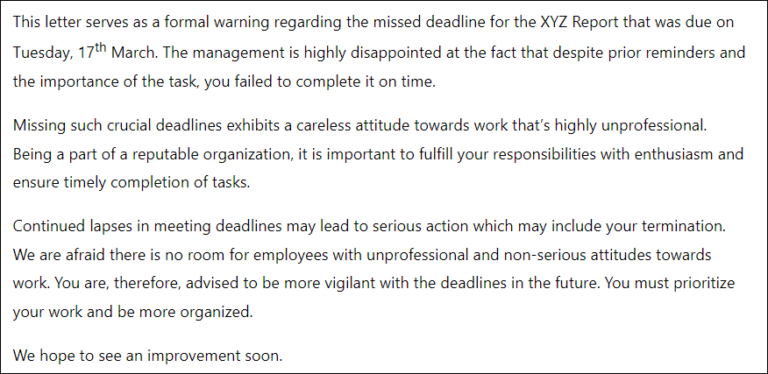
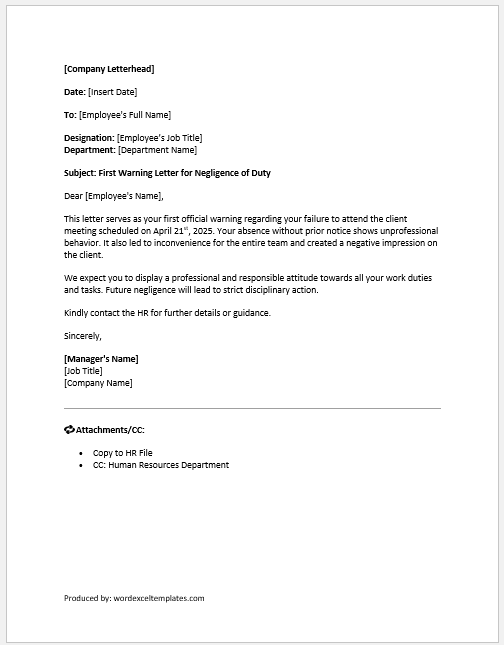
When an employee behaves unprofessionally, companies may initially address the issue through informal methods, such as guidance, verbal warnings, or counseling. However, if the behavior continues, the company may issue a warning letter. Further disciplinary action may follow if the employee fails to improve, depending on the circumstances and company policy.
A warning letter for unprofessional behavior generally includes:
- Date.
- Employee’s name and designation.
- Employer’s or manager’s name and designation.
- Details of the unprofessional behavior.
- Reference to any previous warnings.
- Relevant company policies and required corrective actions.
- A timeframe for reviewing improvement.
- Possible consequences of continued misconduct.
- A statement of encouragement and expectations for improvement.
This letter is kept in the employee’s personnel file and may be referred to during future reviews. It provides a formal record of the concerns raised and the actions required to address them.
Sample Warning Letter for Unprofessional Behavior
Date: [Insert Date]
Name: Ms. Dora [Last Name]
Subject: Warning Regarding Unprofessional Behavior
Dear Ms. Dora,
On July 29, 20XX, at 3:15 p.m., I came to your office to discuss outstanding requests from one of our most important clients. The client had contacted you repeatedly by email and telephone to request documents. After waiting two weeks without receiving them, he contacted management directly.
Before receiving his call, I had also received reports from your co-workers about delays in the project. I discussed these concerns with you and issued a verbal warning.
When I visited your office to discuss the client’s complaint, you shouted, left the room, and slammed the door in front of me. Other employees witnessed the incident, which disrupted the working environment.
Such unprofessional behavior is unacceptable. This letter serves as a formal warning and will be placed in your personnel file. You are required to communicate respectfully, respond promptly to client requests, and complete assigned tasks within agreed deadlines. If difficulties arise, notify your supervisor so that they can be addressed.
You have been with the company for more than three years, and we value your contributions. We are giving you an opportunity to address these concerns. Continued misconduct or failure to improve may result in further disciplinary action, including suspension or termination, in accordance with company policy.
Please contact the client promptly, apologize for the delay, and arrange delivery of the outstanding documents. We will review your progress on [Review Date].
We expect immediate and sustained improvement in your conduct and performance.
Regards,
Bill Smith
[Designation]
[Company Name]

MS Word [.docx]