Employee turnover can involve much more than the cost of advertising and hiring a replacement. When an employee leaves, a business may experience recruitment expenses, vacancy-related productivity loss, temporary coverage costs, onboarding and training expenses, and reduced productivity while the new employee becomes fully effective.
The Employee Turnover Cost Calculator below helps estimate these costs for an individual employee or position. Enter the employee’s annual salary, expected vacancy period, recruitment and hiring expenses, onboarding costs, productivity-loss assumptions, separation costs, and other relevant expenses. The calculator automatically combines these figures to estimate the Total Turnover Cost and shows the result as a percentage of annual salary.
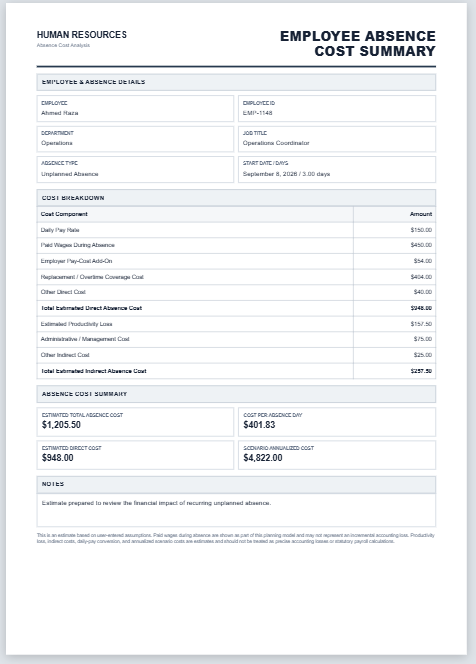
Because turnover costs vary by position and organization, the results should be treated as a planning estimate rather than a fixed replacement cost. You can adjust the assumptions to reflect your own circumstances, review the cost breakdown in the Live Preview, and use Print / Save PDF to create an A4 turnover-cost summary for internal analysis or workforce planning.
Frequently Asked Questions
What is employee turnover cost?
Employee turnover cost is an estimate of the financial impact of losing and replacing an employee. It can include recruitment, vacancy, temporary coverage, onboarding, training, productivity loss, separation, and other replacement-related costs.
How does the calculator estimate total turnover cost?
The calculator adds recruitment and hiring costs, vacancy and coverage costs, onboarding and training costs, estimated new-hire productivity loss, separation or exit costs, and any other turnover-related costs entered by the user.
How is vacancy productivity loss calculated?
The calculator estimates daily pay from annual salary and working days per year, then applies the vacancy period and the selected productivity-loss percentage. Coverage costs such as contractors or overtime are entered separately, so avoid counting the same vacancy impact twice.
Why does the calculator use working days per year?
Working days per year are used to estimate daily pay for the vacancy-loss calculation. The calculator uses 260 as a common planning assumption, but you can change it to match your organization.
What does new-hire productivity loss mean?
New-hire productivity loss represents the estimated cost of reduced productivity while a replacement employee is learning the role and becoming fully effective. The calculator expresses this as a percentage of annual salary.
What is included in recruitment and hiring cost?
Recruitment cost can include advertising or job-posting fees, recruiter or agency fees, HR or recruiter time, interview and selection costs, and background or pre-employment expenses.
Can I use a different currency?
Yes. The calculator supports multiple currencies including USD, PKR, GBP, EUR, AED, SAR, INR, CAD, and AUD. Changing the currency changes the displayed monetary format; it does not convert entered values using an exchange rate.
What does cost as a percentage of salary mean?
This figure compares the estimated total turnover cost with the employee's annual salary. It can help show the relative size of the replacement cost, but it should be treated as an estimate rather than a universal benchmark.
Can I print or save the turnover cost report as a PDF?
Yes. Use the Print / Save PDF button in the Live Preview. Your browser's print dialog can be used to print the A4 report or save it as a PDF.
Are turnover-cost estimates exact?
No. The results depend on the assumptions and values you enter. Vacancy impact, productivity loss, hiring costs, onboarding time, and indirect costs can vary substantially by role, location, and organization.
Understanding Employee Turnover Costs
The cost of replacing an employee can extend beyond recruitment expenses. A vacant position may reduce productivity, require overtime or temporary coverage, and consume staff time during recruitment and interviews. After a replacement is hired, the organization may also incur onboarding and training costs while the new employee works toward normal productivity.
The calculator groups these costs into separate categories so that each assumption can be reviewed rather than relying on a single fixed turnover-cost percentage.
What Costs Are Included?
The calculator can include recruitment and hiring costs, vacancy and coverage costs, onboarding and training expenses, new-hire productivity loss, separation costs, and other turnover-related expenses.
Recruitment costs may include job advertising, agency fees, HR or recruiter time, interviews, and pre-employment checks. Vacancy costs can include estimated productivity loss as well as temporary staff, contractor, or overtime expenses used to cover the vacant position.
Onboarding costs may include administrative activities, training, and manager or mentor time. Separation costs and other organization-specific expenses can also be included when applicable.
How Vacancy Cost Is Estimated
The calculator uses annual salary and working days per year to estimate daily pay. The vacancy period and the productivity-loss percentage are then used to estimate the financial impact associated with an unfilled position.
The default 260 working days per year is a planning assumption and can be changed to reflect your organization.
If you also enter temporary staff, contractor, overtime, or other coverage costs, make sure these represent costs separate from the productivity-loss estimate. This helps avoid counting the same vacancy impact twice.
New-Hire Productivity Loss
A replacement employee may require time to learn systems, processes, customers, responsibilities, and organizational procedures before reaching expected productivity.
The New Hire Productivity Loss % of Salary field provides a simple way to include an estimated cost for this transition period. Because ramp-up time differs significantly between positions and organizations, this percentage should be based on a reasonable internal assumption rather than treated as a universal rate.
Interpreting Cost as % of Salary
In addition to the total estimated turnover cost, the calculator compares that amount with the employee’s annual salary.
For example, if an employee earns $50,000 per year and the estimated turnover cost is $15,000, the turnover cost equals: 15,000/50,000×100=30%
This percentage can make it easier to compare turnover estimates across positions with different salary levels. It should not, however, be interpreted as a standard turnover rate that applies to every employee.
How Businesses Can Use the Estimate
The calculated result can support workforce planning, retention analysis, hiring-budget preparation, replacement-cost estimates, and internal HR discussions.
It can also help identify which components contribute most to the estimated cost. For one position, vacancy-related productivity may be the largest factor, while another role may have higher recruitment, training, or onboarding costs.
Review Your Assumptions
Employee turnover costs are estimates rather than fixed amounts. Actual costs can vary according to the position, salary, labor market, time required to recruit a replacement, vacancy duration, training requirements, and the time a new employee needs to become fully productive.
Review each input before using the result for planning or management decisions. The calculator performs calculations based on the information entered; it does not independently determine the actual financial impact of an employee leaving.