Installing a solar power system is one of the smartest long-term investments for homeowners and businesses looking to reduce electricity costs and become less dependent on the utility grid. However, estimating the total installation cost can be challenging because many factors influence the final price. A Solar Panel Installation Cost Calculator simplifies this process by providing an instant estimate based on your energy needs, property size, location, and system specifications.
Our Solar Panel Installation Cost Calculator is designed to help users understand the expected investment before contacting solar installation companies. Instead of relying on rough estimates, you can enter important details such as your average monthly electricity consumption, available roof area, preferred solar panel type, battery backup requirements, inverter type, labor charges, and local installation costs. The calculator then generates a detailed cost breakdown, allowing you to make informed financial decisions.
One of the most valuable features of the calculator is its ability to estimate the recommended solar system size. Based on your monthly electricity usage, it suggests the appropriate system capacity in kilowatts (kW), helping you avoid purchasing an oversized or undersized system. It also estimates the number of solar panels required, making project planning much easier.
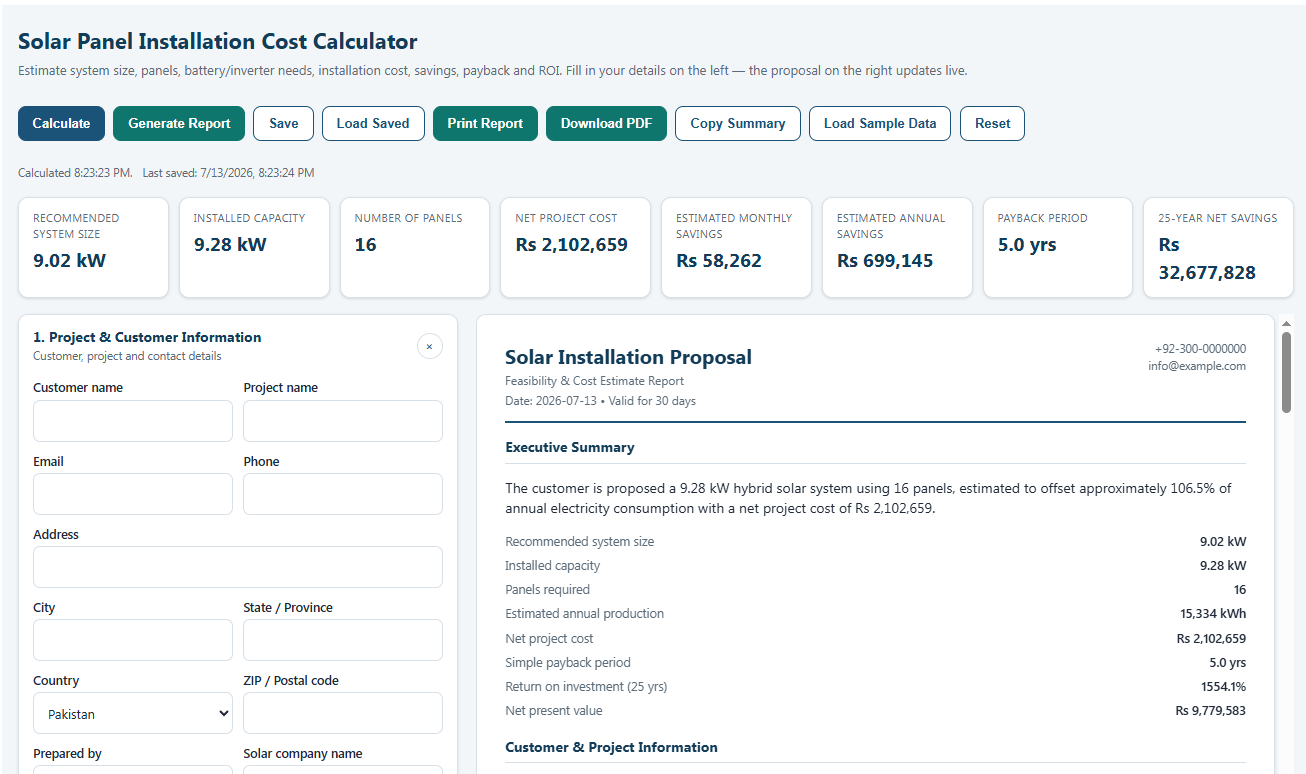
Solar Panel Installation Cost Calculator
Estimate system size, panels, battery/inverter needs, installation cost, savings, payback and ROI. Fill in your details on the left — the proposal on the right updates live.
| Item | Qty | Unit cost | Total | On |
|---|
| Item | Amount | On |
|---|
Frequently Asked Questions
The calculator provides a comprehensive breakdown of installation expenses, including the cost of solar panels, inverters, mounting structures, batteries (if selected), wiring, safety equipment, labor charges, permits, transportation, and miscellaneous installation costs. This detailed estimate helps users understand where their money will be spent and identify opportunities to reduce costs without compromising system quality.
Beyond installation expenses, the calculator estimates your potential monthly and annual electricity bill savings. By comparing your current electricity costs with the expected energy generated by the solar system, it provides an estimate of your future savings. It also calculates the expected payback period, showing approximately how many years it may take for your energy savings to recover the initial investment.
Another useful feature is the return on investment (ROI) analysis. The calculator estimates long-term financial benefits over the expected lifespan of the solar system, which is typically 25 years or more. This helps homeowners and businesses evaluate whether installing solar panels is a financially worthwhile decision.
For users considering battery storage, the calculator includes optional battery sizing and cost estimation. It can estimate battery capacity based on your backup power requirements and include those costs in the overall project estimate. Similarly, users can compare different panel technologies such as monocrystalline and polycrystalline panels to understand how equipment choices affect the total installation cost.
The calculator is suitable for residential homes, commercial buildings, offices, schools, warehouses, farms, and small industrial facilities. Whether you are planning a new installation or comparing quotations from multiple solar companies, it provides a reliable starting point for budgeting and decision-making.
Using the Solar Panel Installation Cost Calculator saves time, improves budgeting accuracy, and helps eliminate uncertainty during the planning stage. While actual installation costs may vary depending on market prices, labor rates, and local regulations, the calculator provides a realistic estimate that helps users prepare for their solar investment with greater confidence. It is an excellent planning tool for anyone interested in reducing energy costs, increasing property value, and making the transition to clean, renewable energy.