Stock Reorder Calculator

Kate

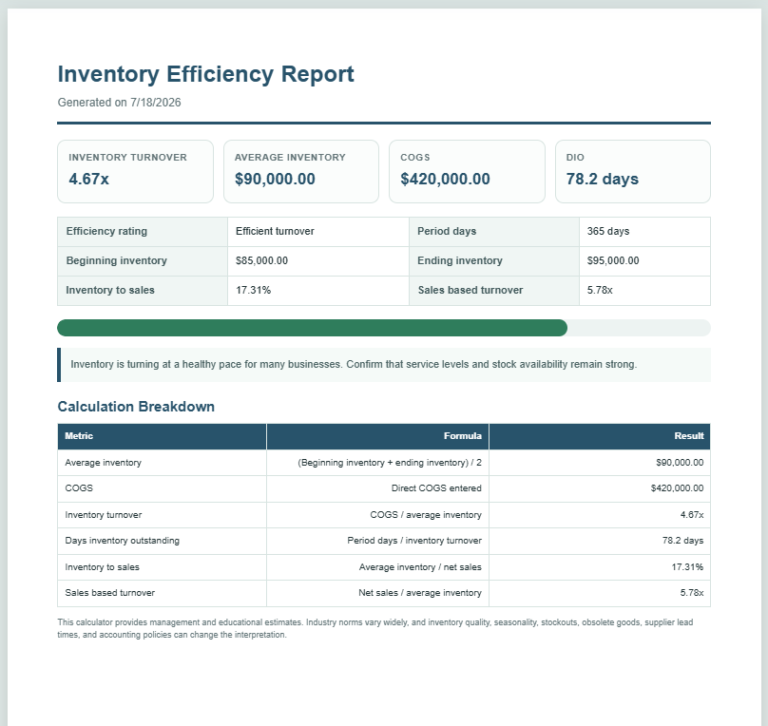
The Stock Reorder Calculator helps businesses determine the right time to replenish inventory before stock levels become too low. It is designed for maintenance departments, warehouses, manufacturing facilities, retail stores, and other organizations that manage spare parts or operational supplies. By entering basic inventory information, the calculator estimates the reorder point, safety stock, suggested order quantity, inventory position, and days of available stock. These calculations help reduce stock shortages while avoiding unnecessary overstocking.

This calculator considers important inventory factors such as average daily usage, supplier lead time, current stock, outstanding purchase orders, backorders, and review periods. It also supports multiple safety stock methods and estimates the Economic Order Quantity (EOQ), making purchasing decisions more practical and cost-effective. The live preview updates instantly as values change, allowing users to review results before printing a professional A4 report.

Whether you manage maintenance materials, industrial spare parts, consumables, or general inventory, this calculator simplifies reorder planning and improves inventory control. It helps purchasing teams maintain the right stock levels, reduce emergency orders, improve supplier planning, and minimize carrying costs. With its responsive design, automatic calculations, printable report, and easy-to-use interface, the Stock Reorder Calculator is a practical tool for everyday inventory management and efficient operations.

Stock Reorder Calculator

Calculate the reorder point, safety stock, suggested order quantity, stock coverage, and purchasing status.

EOQ is calculated when annual demand, order cost, unit cost, and holding rate are greater than zero.
Live Preview

Stock Reorder Report

Operations & Maintenance Inventory Planning

Generated
Industrial Air Filter
SKU: AF-2048  |  Unit: pieces  |  Supplier: Prime Maintenance Supplies
Purchase Status
Order Now
Inventory Position 110
Days of Supply 11.9 days
Reorder Point 96
Safety Stock 40
Suggested Order 112
Target Stock 208
Estimated EOQ 100
Suggested Order Value $2,072.00

Calculation Details

Average daily usage8 pieces
Lead-time demand56 pieces
Maximum demand during lead time120 pieces
Current stock / on order / backorders95 / 20 / 5 pieces
Expected stockout in11.9 days
Recommended order timingPlace the order now.
Formula: Safety Stock = (Maximum Daily Usage × Maximum Lead Time) − (Average Daily Usage × Average Lead Time). Reorder Point = Lead-Time Demand + Safety Stock.
Current inventory is near or below the calculated reorder threshold. Create a purchase order for the suggested quantity and confirm the supplier lead time.

Frequently Asked Questions

A stock reorder calculator estimates when new inventory should be ordered and how much should be purchased. It uses demand, supplier lead time, safety stock, current inventory, and units already on order.
The reorder point is the inventory level that triggers a new purchase order. It normally equals expected demand during supplier lead time plus safety stock.
Safety stock protects operations against unexpected usage, delivery delays, supplier shortages, and demand fluctuations. It helps reduce the chance of equipment downtime caused by unavailable parts or supplies.
It subtracts normal lead-time demand from the highest expected demand during the longest lead time: (maximum daily usage × maximum lead time) − (average daily usage × average lead time).
Inventory position equals current stock plus units already on order minus backorders or committed units. It provides a fuller purchasing picture than on-hand stock alone.
Economic Order Quantity is an estimated purchase quantity that balances ordering cost and annual holding cost. It is useful as a planning reference but should be adjusted for supplier minimums, storage limits, and actual purchasing conditions.
Place an order when the inventory position reaches or falls below the reorder point. The report also estimates how many days remain before available stock is consumed at the entered average usage rate.
Yes. It can be used for filters, belts, bearings, lubricants, cleaning materials, safety supplies, repair components, and other Operations & Maintenance inventory items.
Review them whenever demand, supplier lead time, cost, storage conditions, or service requirements change. High-use or critical items may need weekly or monthly review.
No. It is a practical planning tool for individual items and purchasing decisions. Larger organizations may also need inventory software for multi-location stock, purchase approvals, supplier records, and transaction history.